
Canary Islands Octopus Farm Plans Blocked Due to Evidence Based Impacts on Ecosystems and Physiological Experience
Political Risk and Environmental Impact Push Project Into Non-Viability
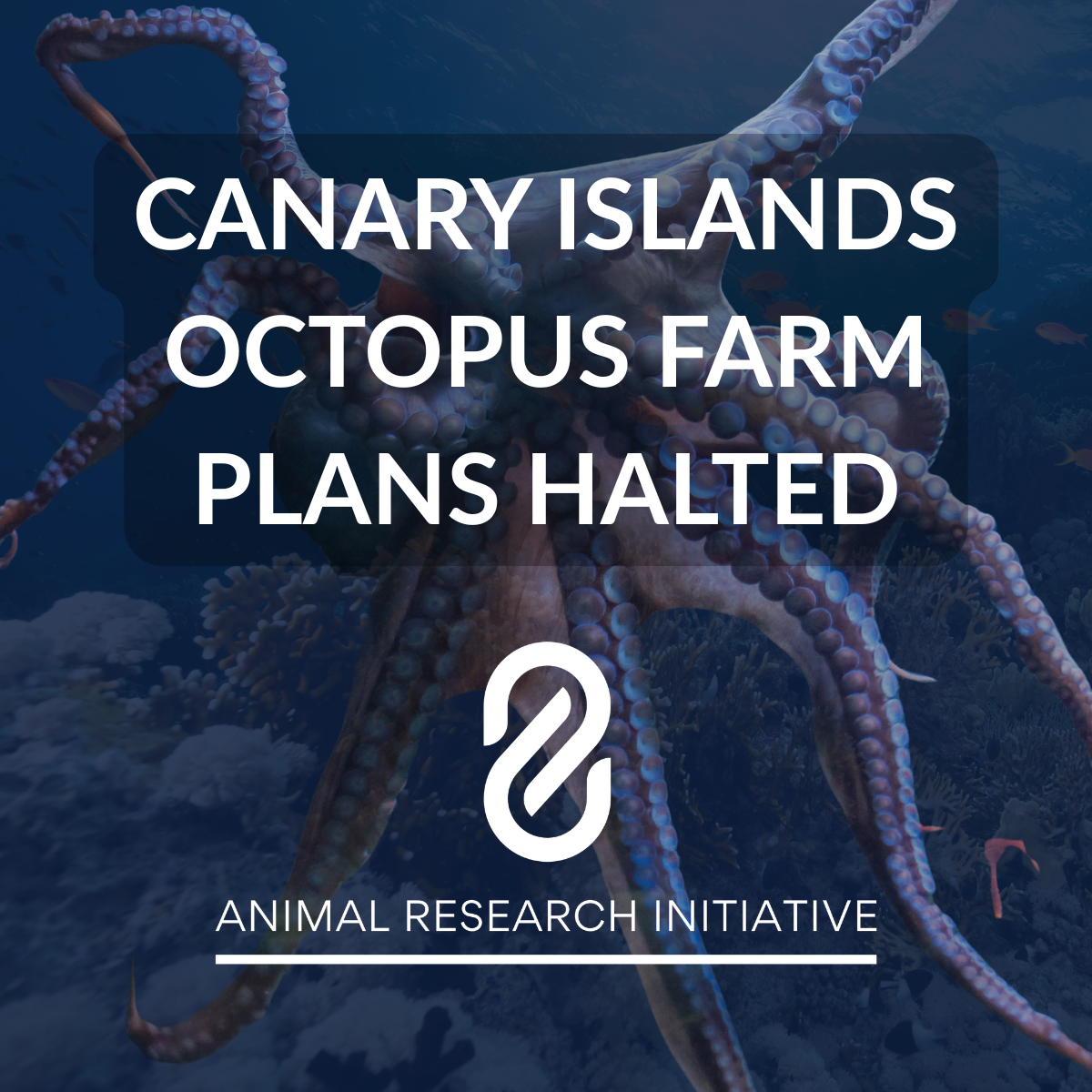
July 23, 2026: Today marks one of the most significant victories yet in the global effort to prevent industrial octopus farming.
Nueva Pescanova (NP) has withdrawn its application to build what would have been the world's first commercial octopus farm in Gran Canaria (AtlanticoHoy, 2026).
This responsible decision has been years in the making.
When BBC revealed these plans in 2021, our National Legislation Organizer, Joshua Diamond, conceived a proactive strategy: prohibit commercial octopus farming prior to establishment (BBC, 2021).
On February 9, 2022, Animal Research Initiative (ARI) presented our proposal to Washington legislators and secured a commitment to sponsor the bill.
What followed demonstrates the power of our science-based proactive policymaking:
-Dec 2021: Plans leaked for the commercial octopus farm in the Canary Islands
-Feb 2022: We proposed to prohibit octopus farming in WA
-Jan 2023: HB1153 was prefiled by Rep. Strom Peterson (WSL, 2023)
-March 2024: HB 1153 signed into law
-Now: In 10 U.S. states/territories and 3 countries
-Jul 2026: Plans officially halted
As the legislation advanced, scientists, specifically Jennifer Jacquet, and a broad coalition of advocates rallied behind the effort, helping secure its successful passage.
Our strategy did not simply oppose one facility, it changed the political risk of the entire industry.
Since WA's landmark law, ARI has introduced similar legislation in nine U.S. states and one U.S. territory, while mirrored efforts have emerged in Chile and Mexico. Throughout this work, our int'l partners have shared that the growing number of U.S. initiatives demonstrated to Spanish authorities that concerns were legitimate scientific and environmental issues deserving serious scrutiny.
The Gran Canaria proposal was never just an animal welfare issue. It represented the deliberate expansion of a predator whose ecological impacts are already being observed in the wild. As octopus populations surge, fisheries in England are reporting severe collapses in crustacean populations. (The Guardian, 2026)
Yet NP has not abandoned its ambitions, stating that withdrawing its application "does not imply any recognition regarding the future viability of other technical, environmental, or location alternatives." It maintains that the environmental review process changed the project's conditions, scope, timelines, and regulatory requirements, not its underlying viability (AtlanticoHoy, 2026). In other words, they will keep searching for a place to become established with less environmental scrutiny.
Researchers and commercial interests in Spain, Japan, and other countries continue investing significant resources into overcoming the biological barriers that have prevented industrial octopus propagation for decades. Instead of accepting these hurdles as evidence of non-compatibility, they continue to remove wild animals from the ocean to perpetuate experimentation.
Today, we celebrate this victory made possible by everyone who believed this industry should never take hold while acknowledging that expanding our work is more important than ever.
ARI will continue working with legislators, scientists, and stakeholders to prohibit the commercial propagation of cephalopods before this industry can establish itself elsewhere.
Help us expand:
ariaction.org/donate